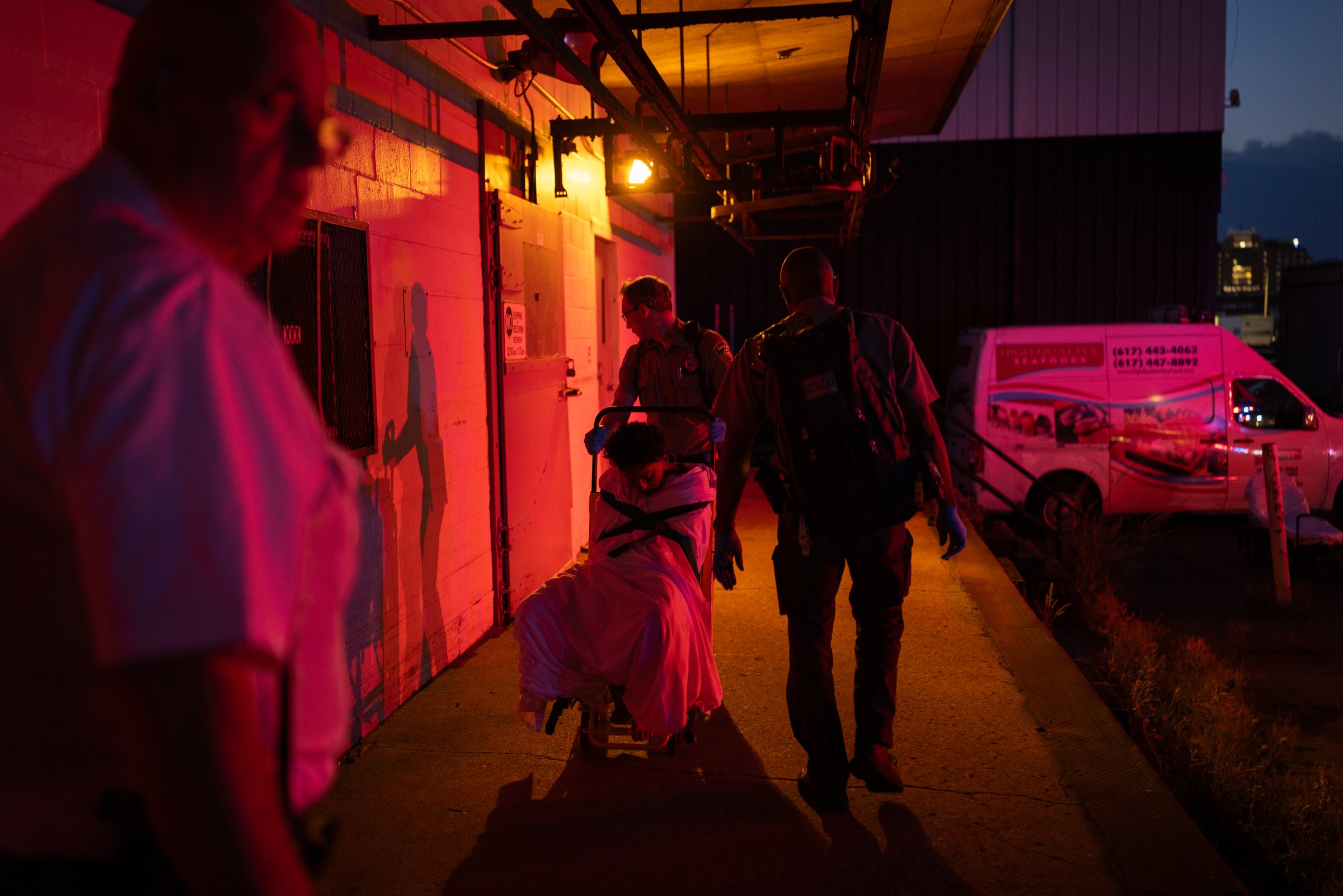
Medics remove a woman from a loading dock off New Market Square.
She was on the loading dock behind the trailers, in the part of the lot where the light does not reach. Getting up there took a jump. The pallets were stacked high and scattered and she was sitting on them in her underwear, barefoot, screaming at something nobody else could see.
Her hands would not stay still, front and back, inside her clothes. She was hunched and turning, throwing herself into positions a body is not built to hold. Her eyes had gone wide and fixed. Whatever she was fighting was in that lot with her and only with her.
Fifteen minutes earlier she had been standing on the road outside a tow yard on New Market Square, a man beside her, eighteen-wheel trailers parked along the curb with no cabs attached to them. Asked if she was all right, she said no. Nothing else she said held together. She was filthy, dirt to the knees, and had almost nothing on.
The man said he had come upon her the same way — that he had just found her there and was wondering the same thing.
He was in better condition than she was. He was in no better condition than the people on the Mile, and he had no business being in that lot at that hour.
Getting water took ten minutes. When the road came back into view it was empty.
She was across the street and up on the dock with him.
Nothing about that spot makes sense unless somebody chose it. It sits off the road behind a wall of tractor trailers. It cannot be seen from the street, it cannot be reached quickly, and it is not a place a person goes for any reason a person could name. The question is not what happened on that dock. The question is why a man in working condition walked a woman in that condition to the one place within a half mile where nobody would find her.
The medics came fast. They could not work out what they were looking at. She gave a name. It is not printed here.
Standing on that dock, I thought: no one should live in this condition. No one should end a night this way — behind a trailer, in the dark, screaming, with a stranger.
This was the end of the line.
It is also the downstream of a street that was cleared three years ago.
The first visit was in 2023. You could stand on Atkinson Street and photograph the whole of it, and it took a morning.
The first warning came within minutes. Walking onto that street with a camera visible, a man at a makeshift desk yelled to come over. He slammed down what looked like a screwdriver. His jaw was sunken — the hollowed look of long-term meth use. He stared and did not stop staring.
Someone shouted from behind to get out of there. A man on the edge of the encampment put it plainly afterward: you were going to get jumped. That was going to happen. Maybe bring a smaller camera next time.
Mass & Cass sits within blocks of some of the best medical centers in the world. Boston University Medical Center rises behind the tents. The skyline is visible from the street. But on Atkinson Street — Boston's skid row — the distance between those institutions and the people living here might as well be measured in years.
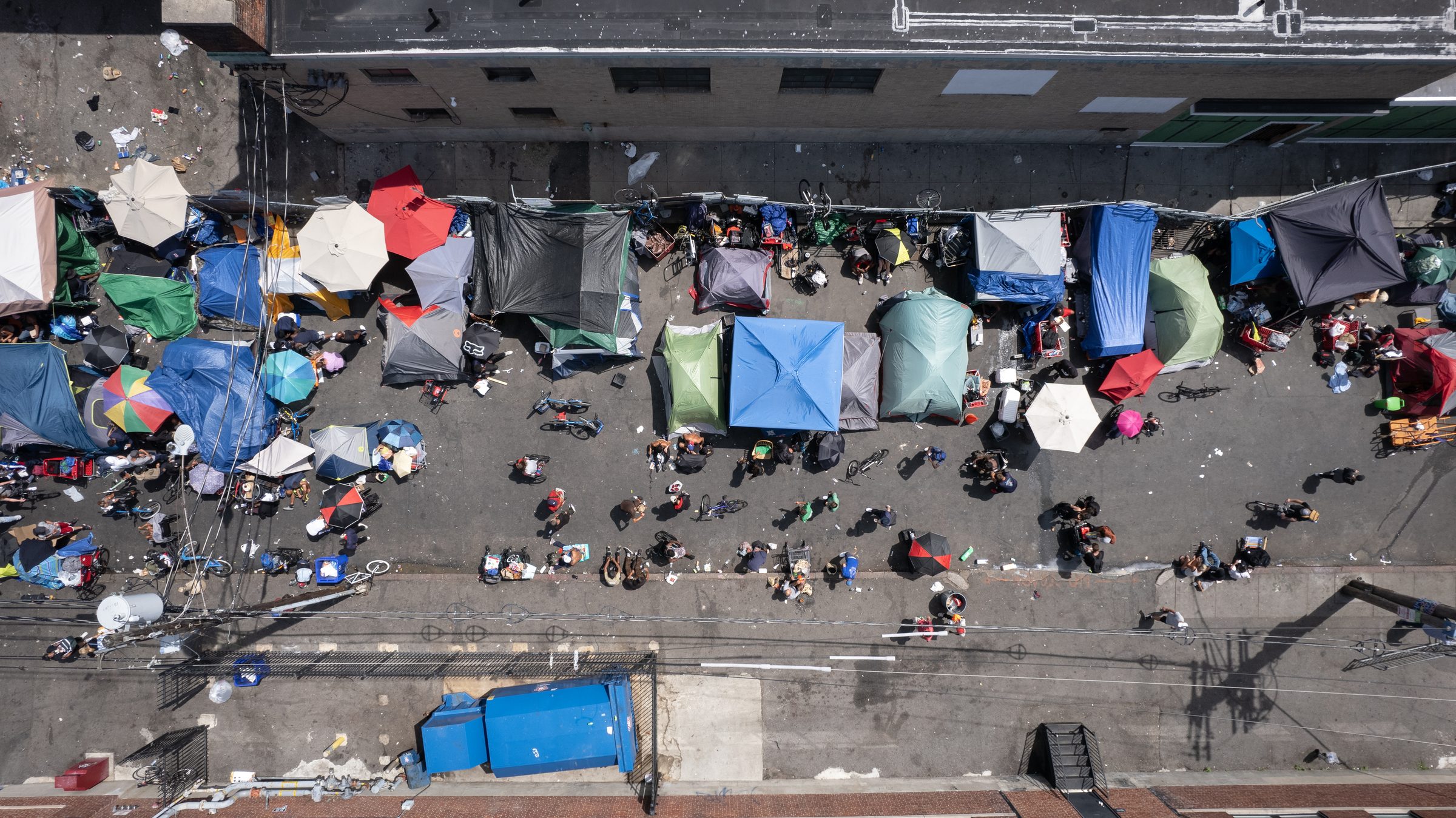
The streets were an open-air market for fentanyl, heroin, and crystal meth. Dealers made morning rounds the way vendors make deliveries. They called it snacks. "It's going to be a long day — get your snacks now." It was easier to find drugs on Mass & Cass than it was to find a bathroom.
The street sticks to your clothing. Smoke from crystal meth drifted through the air between the tents. From above, the encampment looked organized — rows of colorful tarps and shelters pressed against the buildings. At street level, the order dissolved. People sat, slept, and used in the open.
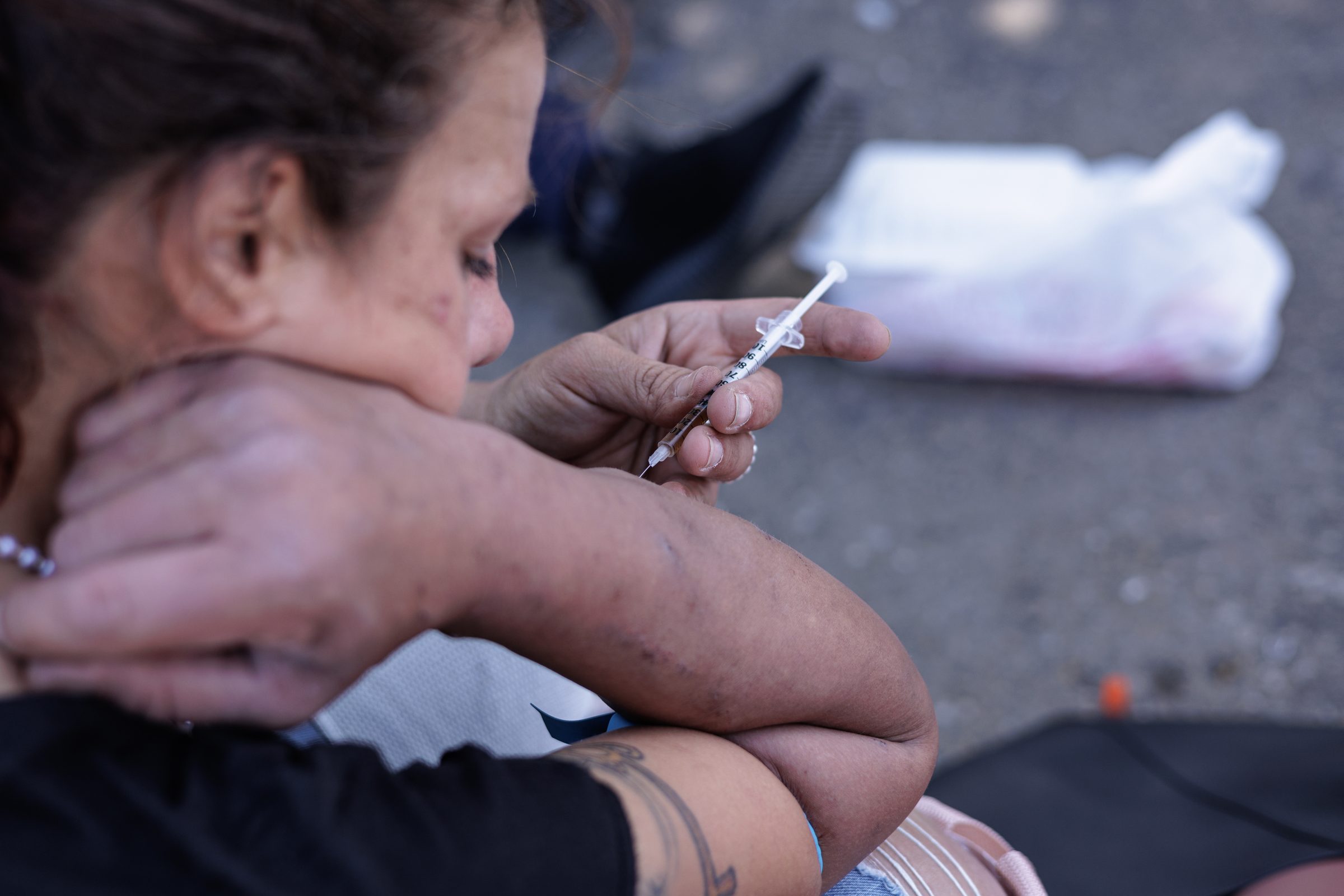
What strikes you is how fast they switch. Up, then down. Crack to meth to heroin to fentanyl — cycling through whatever is available, whatever takes the edge off the last hit or fills the gap until the next one. They poke and poke and poke. Some have nothing left — veins collapsed, arms scarred, searching for anywhere on the body that still takes a needle.
The smell stays long after you leave. It settles into clothing, into hair. Hours later it is still there — burnt chemicals, exhaust, decay. It is not something you notice and move past. It is part of the air itself, part of what everyone here breathes every day.
Patrol officers moved through but the presence felt procedural — a perimeter drawn around a problem nobody had solved. City officials remained at an impasse. Few were willing to treat this as what it is: a humanitarian crisis that can only be understood at the individual level.
The people living here are not an abstraction. They have names.
She had lived on Mass & Cass for over five years. She lost a public housing voucher and moved in with a friend to get back on her feet. When she could not pay for five hundred dollars in drugs, four men held her down and raped her. Tanya contracted HIV through her addiction to crack, crystal meth, and heroin. She had tried to get clean several times, but rehab never fully addressed her struggle, and each time she was put back on the street.
She felt safer out here — protected by a small group of friends — than in the shelters, where she had been sexually assaulted more than once.
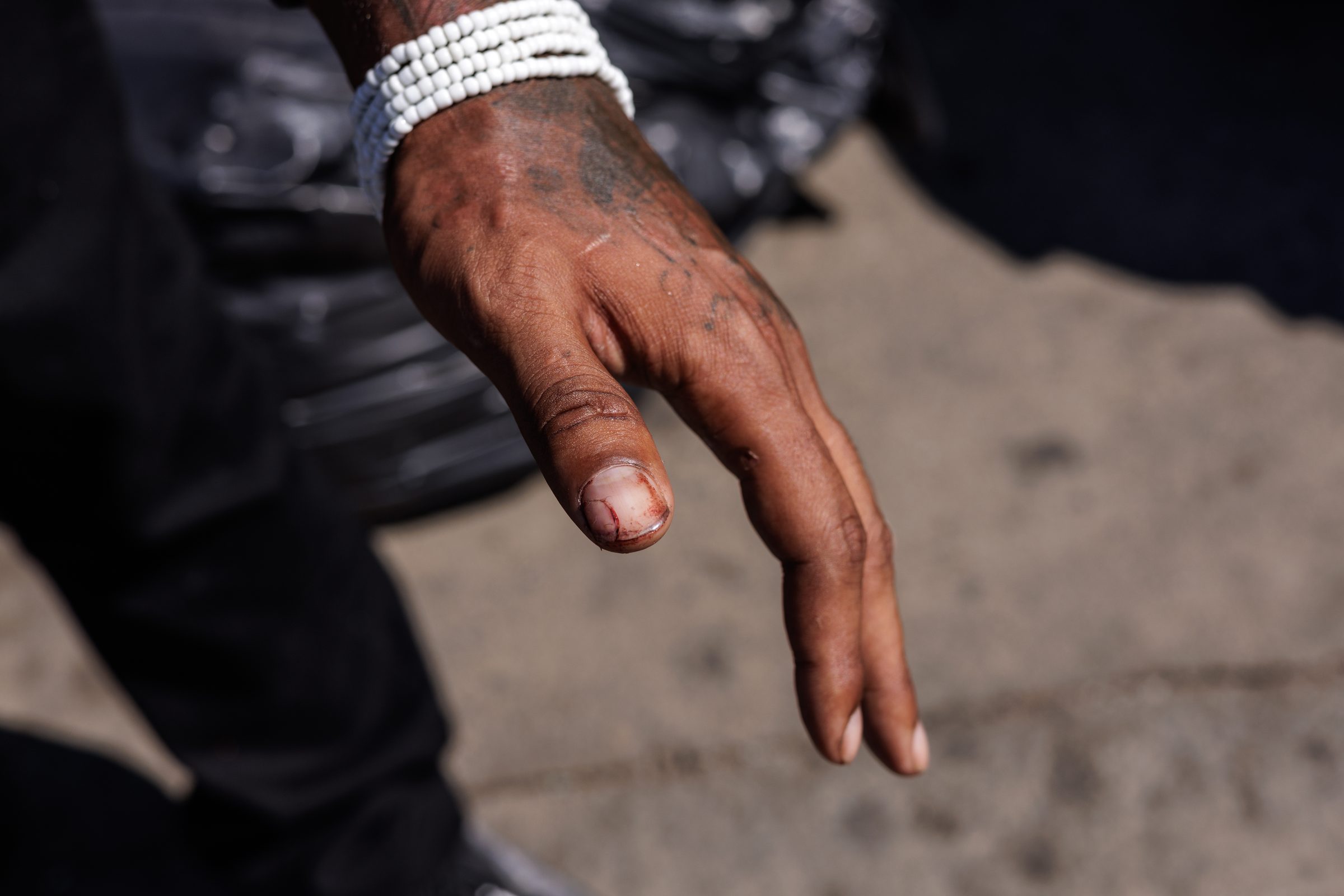
She moved from Georgia to Mass & Cass over five years ago. She had struggled with depression and addiction since she was fourteen. She is the mother of two children — one conceived through rape — and is no longer able to see either of them.
The scars on her body tell a history the words barely reach: she was jumped in the staircase of a parking garage and set on fire. Unlike some on the Mile, she still held a Section 8 voucher, but finding permanent placement while battling addictions to crystal meth and heroin had proved impossible.
Women on the Mile are especially vulnerable — watched, studied, passed by. Some describe it as living in a zoo.
Make no mistake — Methadone Mile is an extremely dangerous place. Accounts of thefts, stabbings, murders, sexual assaults, and human trafficking are constant. Many of the people here feel dehumanized.
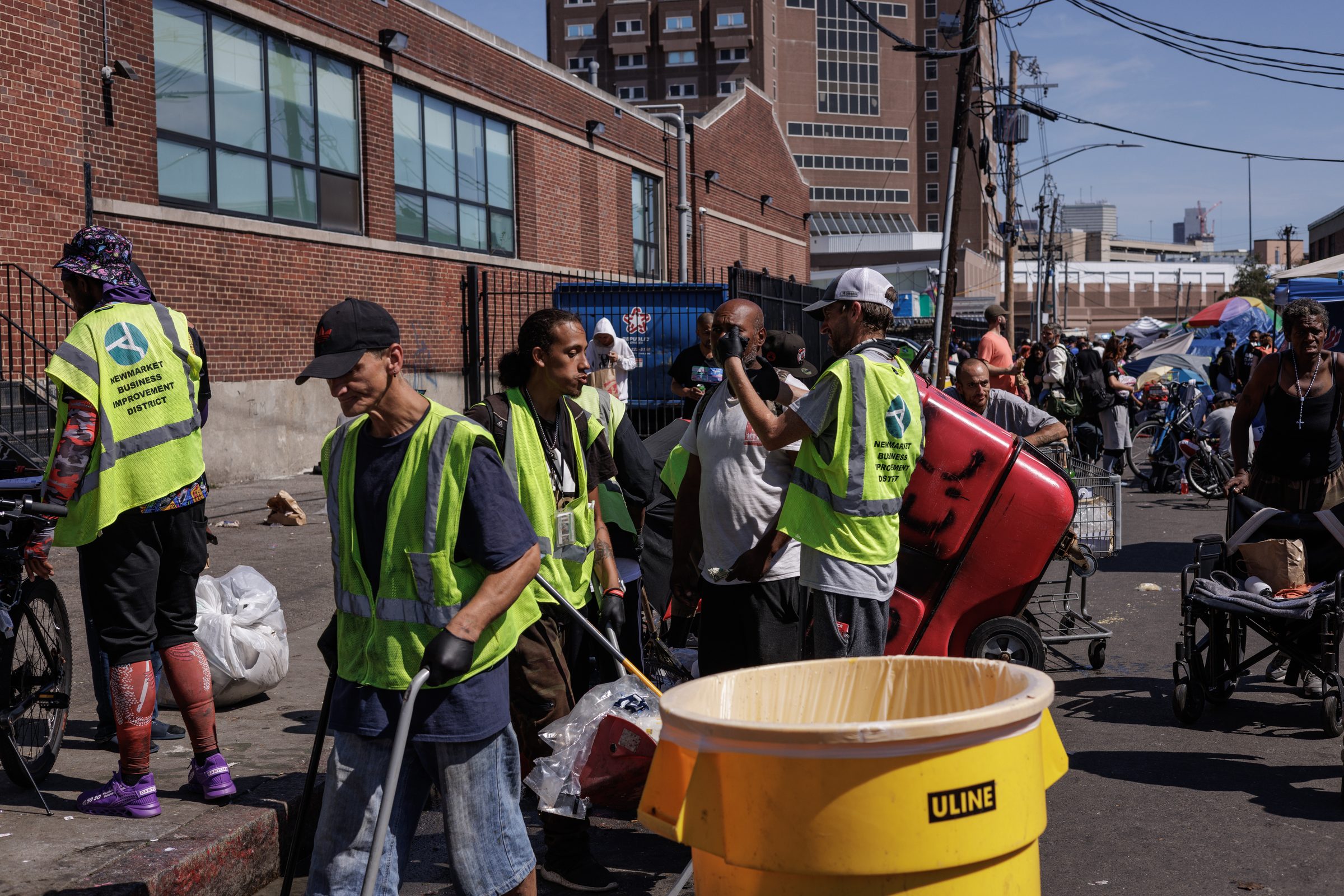
A man from Ohio could not leave Boston because his identification had been stolen. His social security number was gone. Every time he saved enough for a bus ticket home, he was robbed. "That's how they get you. They steal from you when you sleep. In the shelters, if your shoes aren't tied to your body, they'll take them. And even then, maybe they'll cut them off your feet."
Without money, a mailing address for basic paperwork, and the willpower to simply walk away, you are stuck — trapped in a cycle of half-hearted government empathy and deepening addiction.
Amongst the crisis, small acts of kindness persist — food handed out from the back of a car in a gas station parking lot.
Shared misery on Methadone Mile runs as deep as the addiction itself.
A few months after those photographs were made in 2023, the city took the street.
Crews came down Atkinson with a new ordinance behind them and the tents came apart in a matter of days. Officials said nearly everyone had been connected to shelter or services. Lawyers came to watch it happen. By the end of the week the road was open to traffic and the pictures were of a place that no longer existed.
It was not the first sweep and it would not be the last. What the clearing did was move the crisis rather than end it. Within a year the surrounding neighborhoods — the South End, Roxbury, Southie, Dorchester — were telling the city it had arrived on their blocks. Police began walking people from corner to corner. Arrests in the area climbed by half. Then came the cameras, the involuntary commitments, the rules against handing out food on the sidewalk, and fewer clean needles in a fentanyl epidemic, which four hundred doctors and nurses signed their names to a letter to call exactly what it was.
What replaced the encampment is not an encampment. It is dispersal.
The population moved outward into the industrial margins — the tow yards, the loading bays, the rental lots, the blocks with no residents to complain and no windows facing the street. Being counted was the thing that cost them, so they stopped standing anywhere long enough to be counted.
That is the policy achievement. Not fewer people. Fewer people who can be found.
What happens to a woman in those blocks happens where there is nobody to see it.
There are no tents. There is no encampment to walk into. There are maybe a hundred people moving through these blocks — not camped, moving. Circling. Passing through and coming back. You cannot photograph a street that has been emptied. You can only photograph what keeps returning to it.
The first thing you notice is that everyone is watching for police.
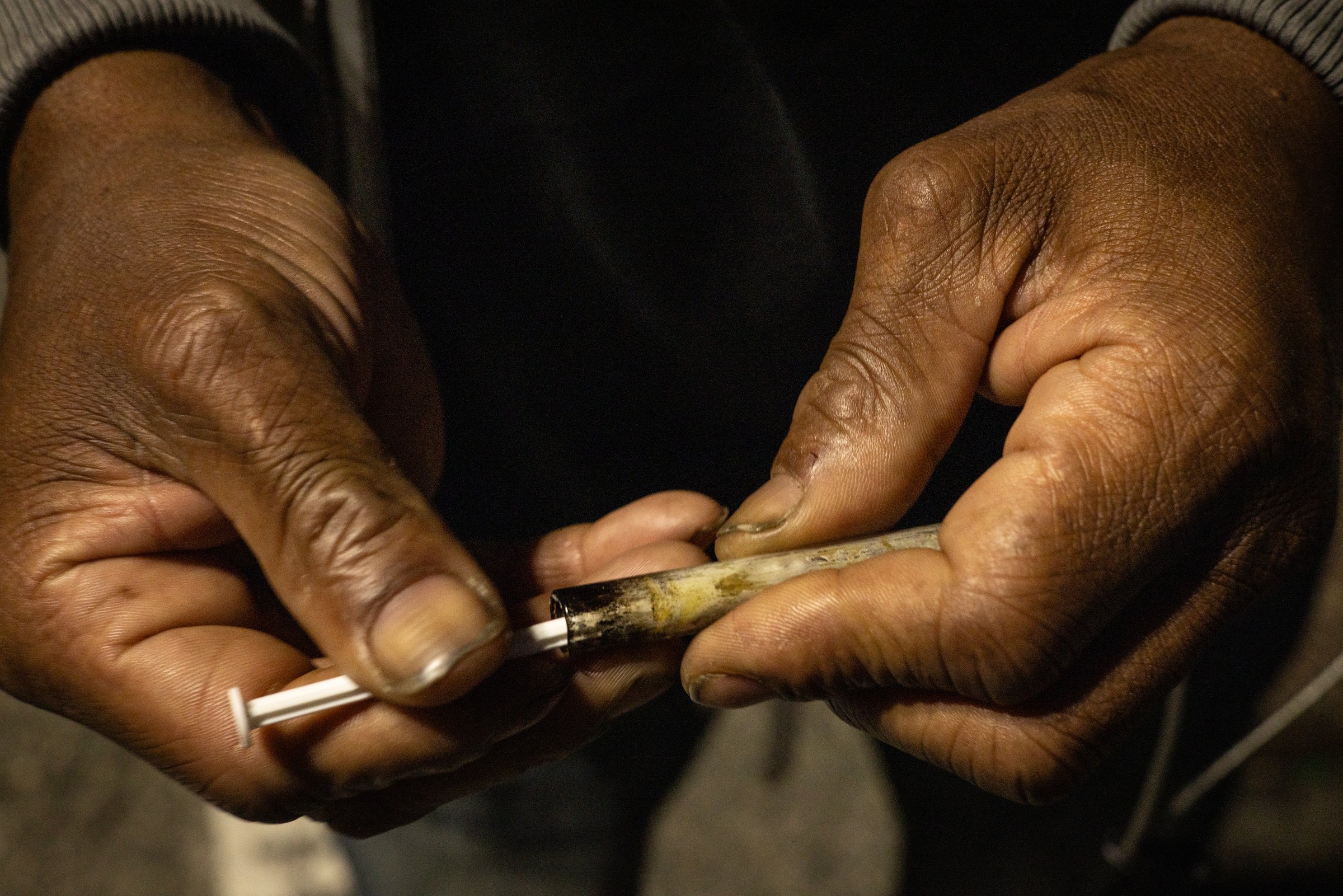
The drug of choice still changes by the day. Some mornings it is meth and dope together. Some mornings crack and fentanyl. There is K2 out here now too, cheap synthetic, and it is the reason more than one person on this street is wearing a healing wound on their face. They switch fast and they cycle, the same way they did before, running on whatever the street has that morning.
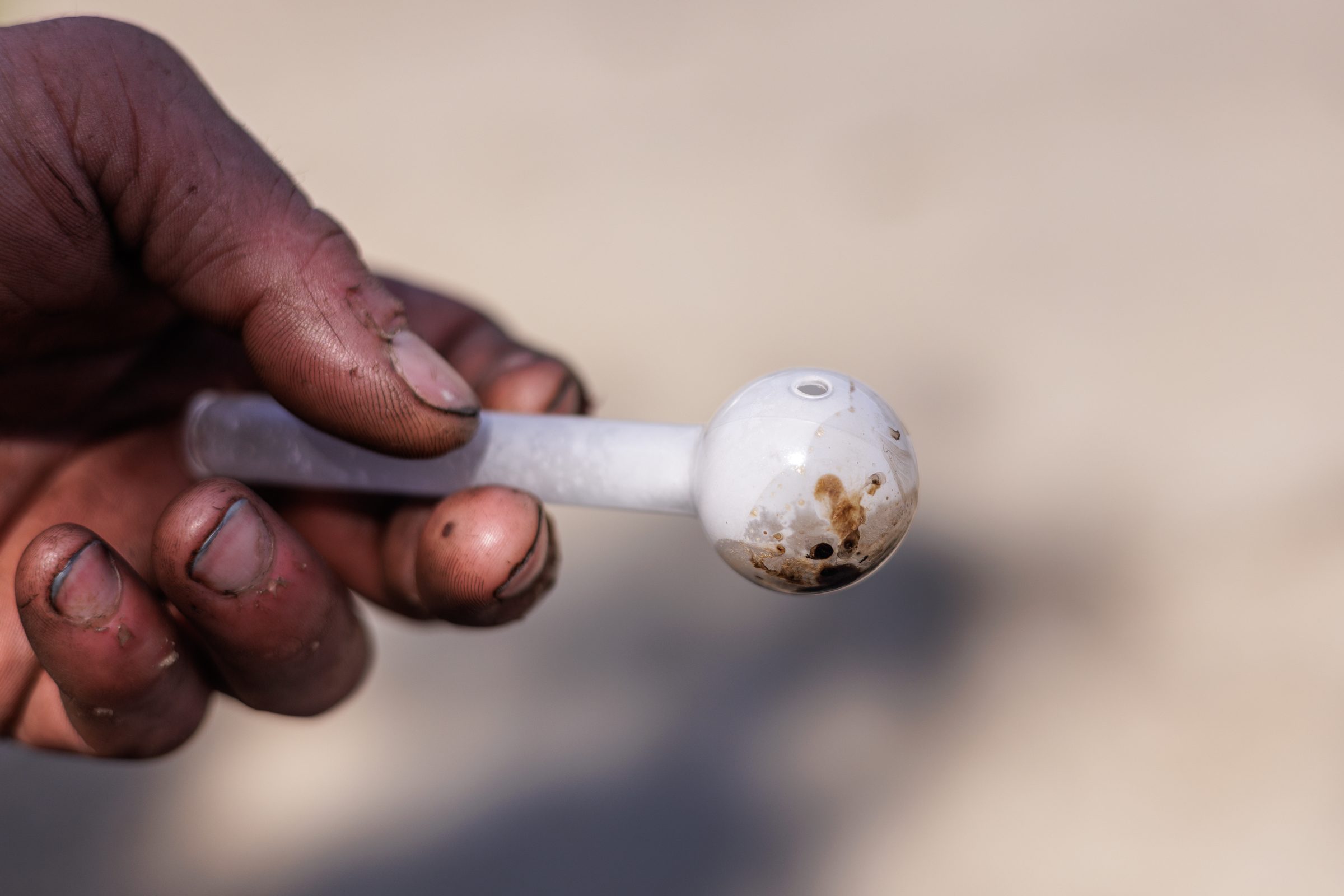
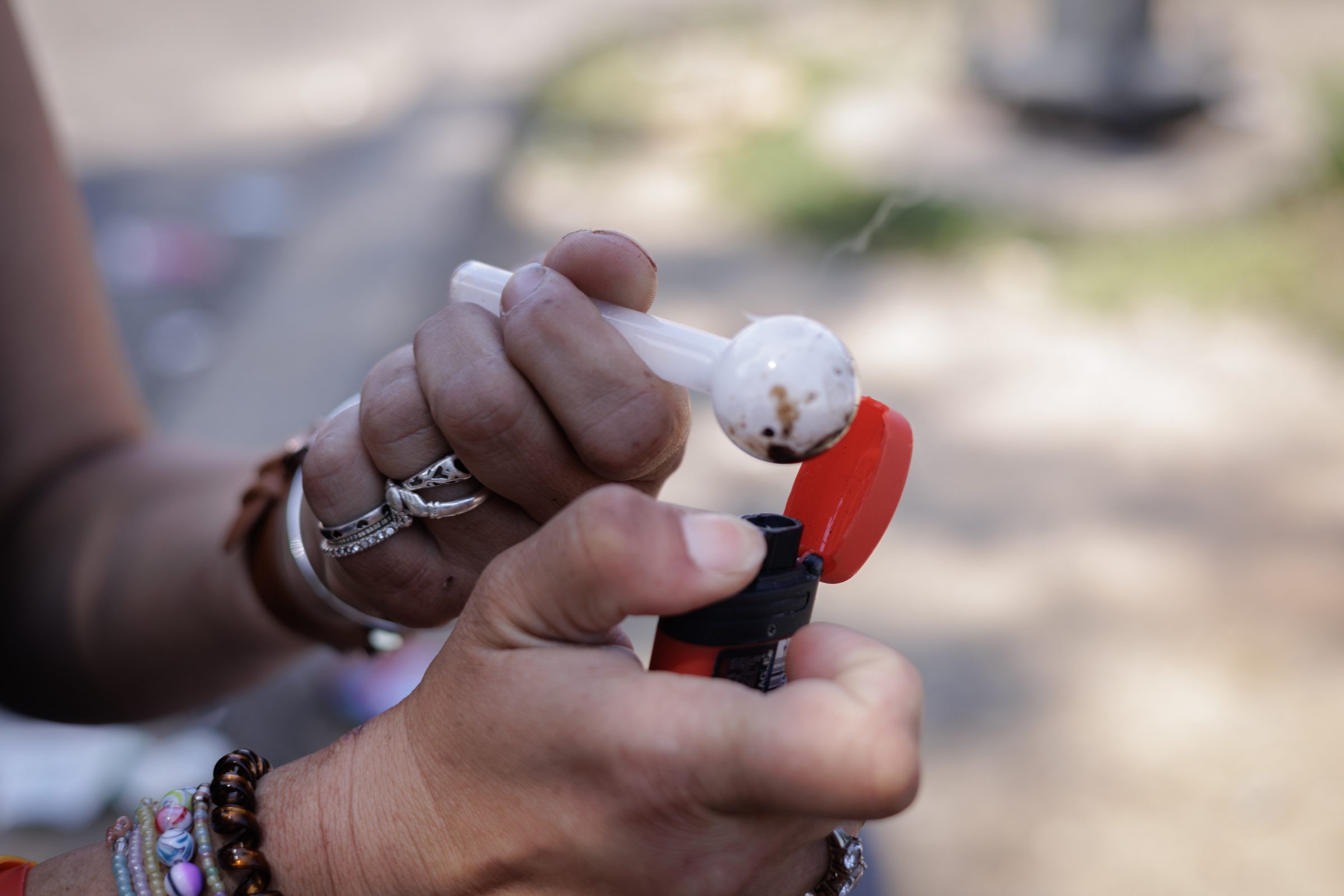
What is different is the equipment. Glass stems. Nips — the little airline bottles — pulled from the gutter and repurposed. Spoons, soda cans, bottle caps, whatever holds still. And in nearly every hand, a packer. The tools are improvised, personal, and never set down.
The Mile is not one population and it never was. There are construction workers. There are migrants. One man had come from Caracas, north through the Darién Gap with his two children. He hurt his leg somewhere in the crossing. He carried them the length of a continent, and he stayed on the crack the entire time anyone was there to watch — that is his hand, holding the stem.
Behind him another man was working at both legs, hunting for a vein. Both were swollen. The socks had left a deep imprint at the ankle, the kind that shows up in heart failure. Asked whether they hurt, he said not really — he just needed to clean them up a bit. Told they did not look good, he shrugged it off.
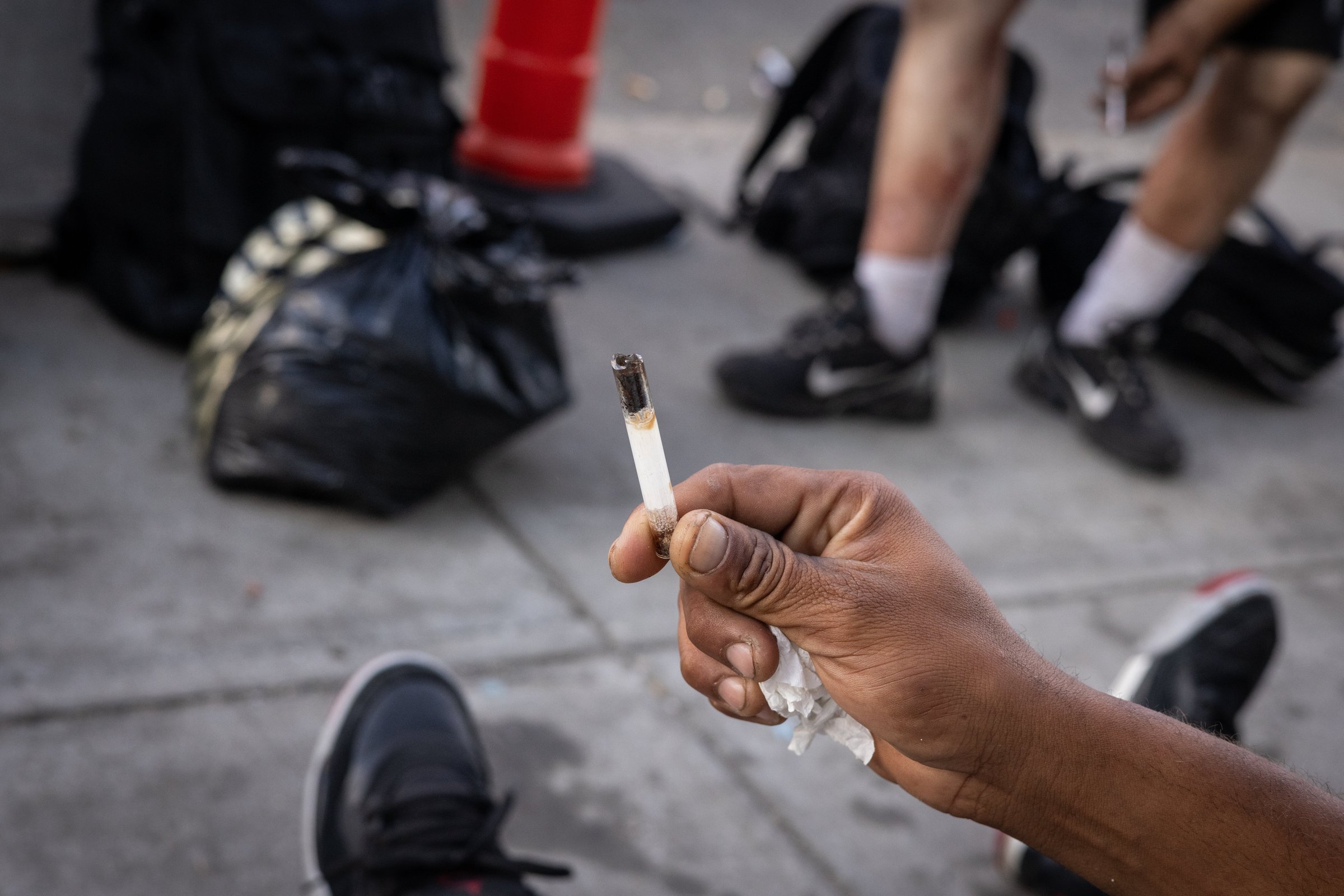
Compared to others out here with their legs rotting from the inside out, I think I'm doing pretty good.
One man with black, worn hands wanted his picture made — but only at his worst. Not before. He wanted to be seen at the bottom of it. He took a couple of cigarettes and said he would be back in a half hour. He was not there yet. Then he started cycling.
Cameras have been coming through here for years. Most people now will only be photographed for money, and that is not an arrangement this work will enter into.
He has been on the Mile more than nine years. He is not only addicted to the drugs; he says he is addicted to the streets themselves.
The wounds on his face are not from a fight. He fell on it, using K2. It was not the first time — he has gone down this way before and hit the pavement face-first. That is what the synthetic does. People drop where they stand, and the street is concrete, and they get up and do it again.
Devin asked to be photographed and asked to be named. He wanted the face in it. He wanted people to see what the drug does to a man who is still standing there talking to you afterward.
Asked what he does during the day, he said he steals. That is how he makes money. He said it without defensiveness and without apology — not a confession, a description of how the economy works out here. The Mile has its own.
What he wants is to be free.
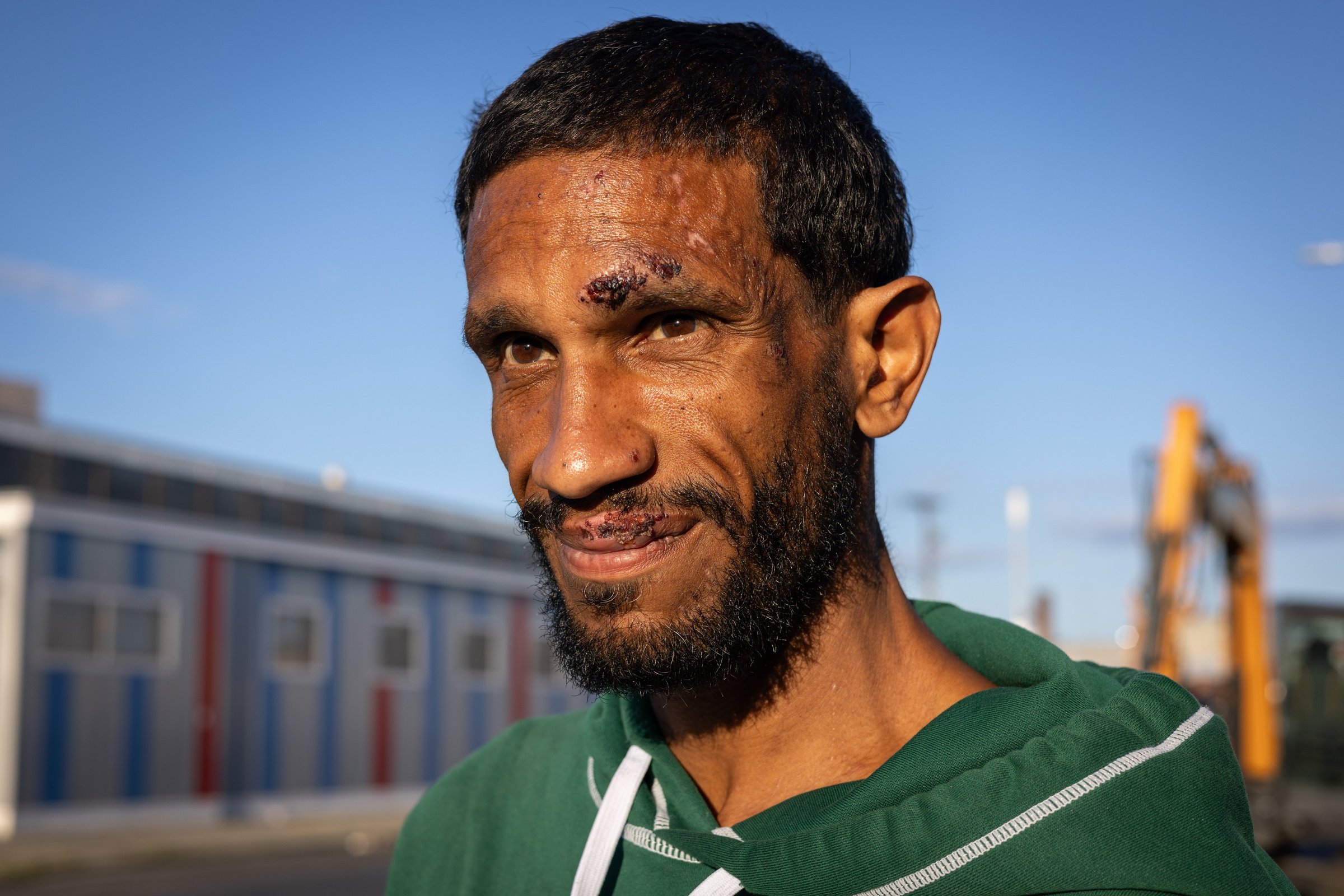
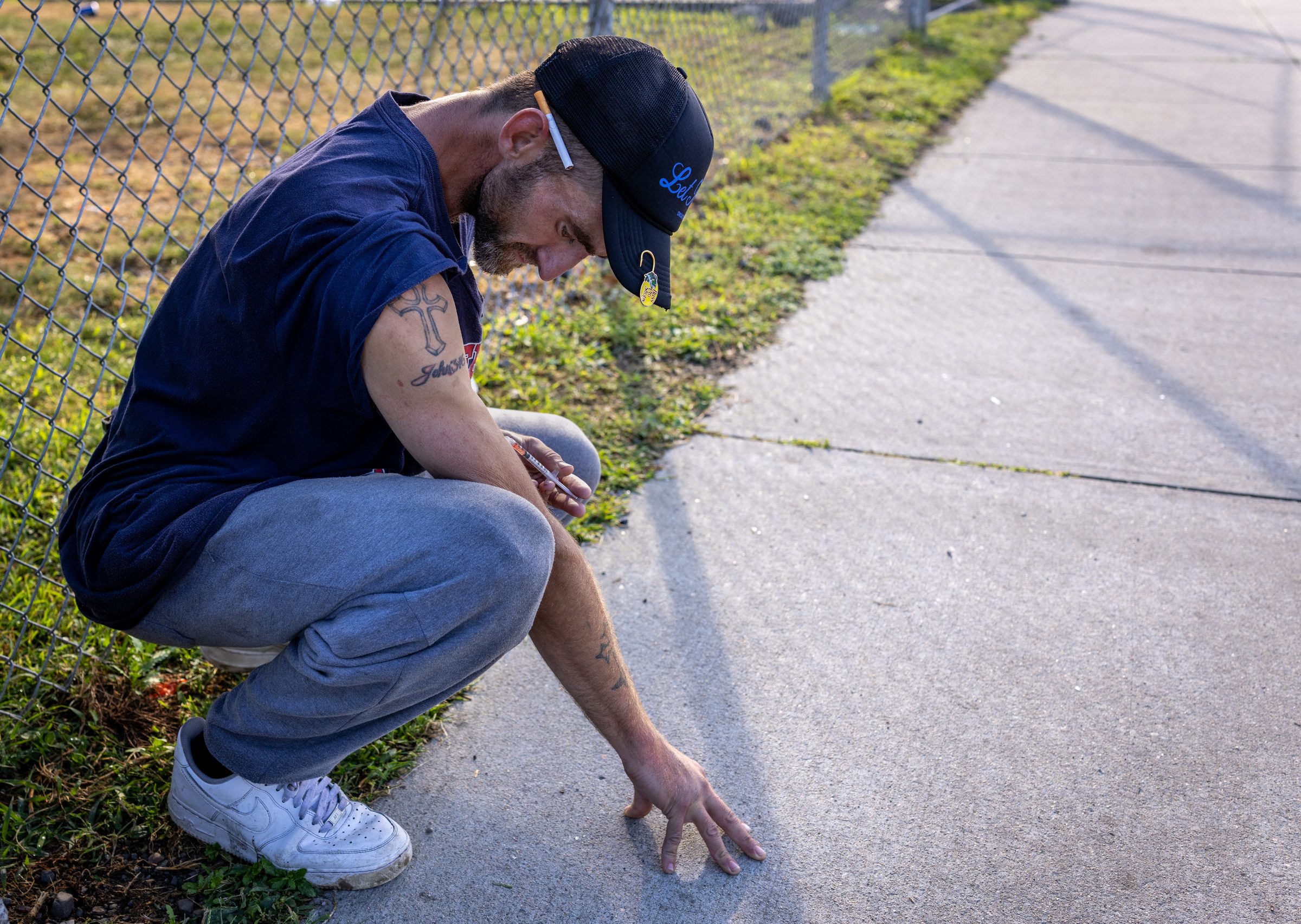
He has been on the Mile for years. He was easy to talk to in a way that was not expected — he talked, he introduced the two men he was standing with, and when it came time for him to use he never asked for the camera to be put down.
He asked for a step away from the group first. Not for his own privacy. He did not want a photographer standing with them with a camera out, because he was certain it would get that person targeted.
He worked out the logistics of his own exposure in order to protect a stranger's.
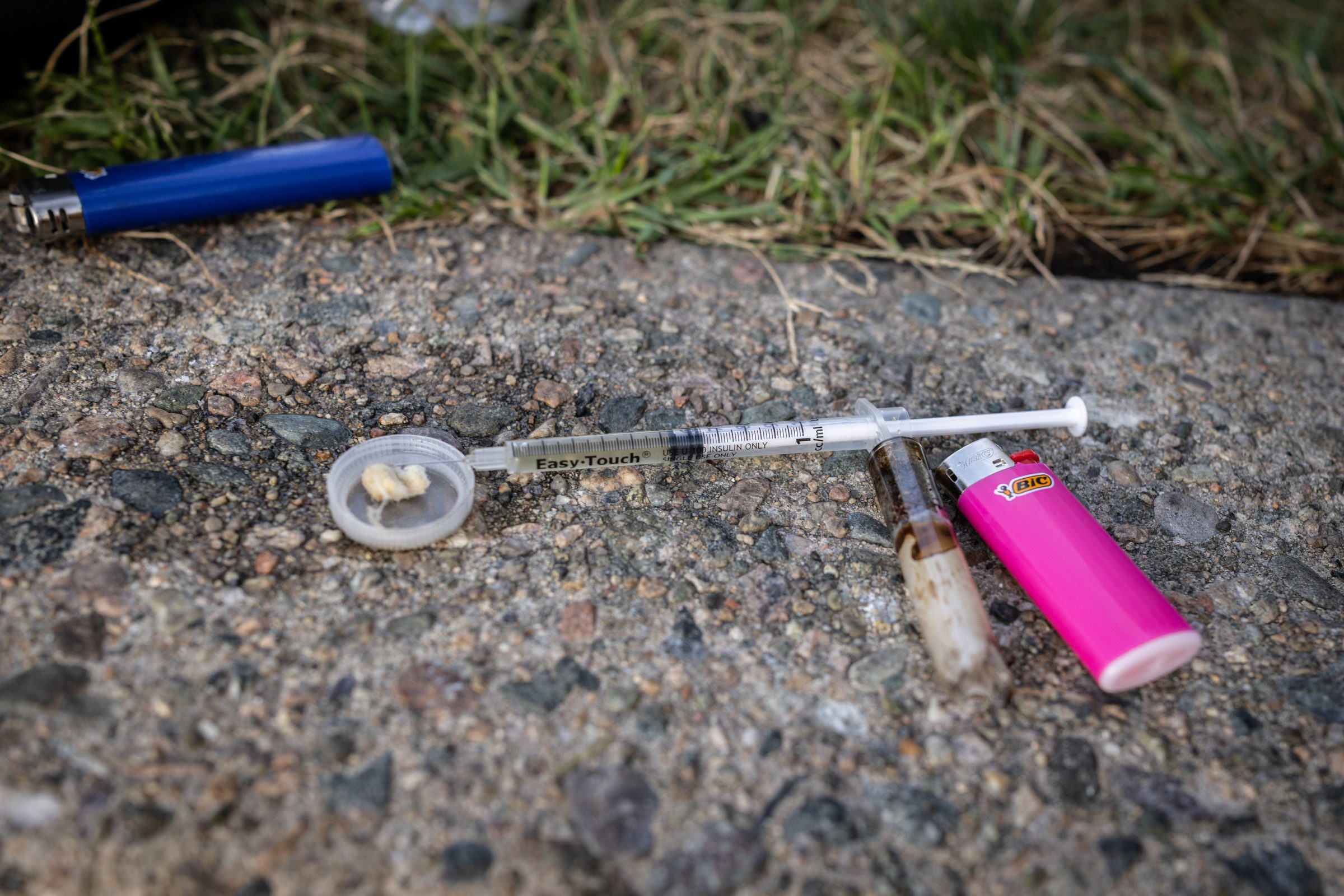
He used in the strip of grass between the chain-link and the sidewalk. There is maybe eighteen inches of it. Everything to his right is open concrete — swept, empty, and reopened to traffic three years ago. That is the whole geometry of the Mile now. The street belongs to the city. The margin is what is left.
One of the men he was standing with called the Mile a war zone. The second man disagreed, but not in the direction you would expect. He said it is quiet right now. He said that in fourteen years out here he has learned to read it, and that it is changing, and that it is about to explode.
What he is predicting is not clear. It is down here because he has stood on this street for fourteen years.
That is the question this street keeps asking, and nobody standing on it has an answer. There were more than a hundred people living in those tents and twice that passing through each day. The tents came down in a week. The people did not evaporate.
Some went into treatment. Some went into the neighborhoods. Some went to jail. Most went nowhere at all — they simply stopped standing in one place long enough to be counted.
What everyone describes now is the same arrangement: get clean or go to jail. For a person who wants to stop, that is an open door. For a person who does not — and many out here do not, because the high is the last thing that still works — it is not an offer at all. It is a choice between two kinds of custody. So they keep moving. They avoid the corners where the vans park. They stay out of view, which is the one thing the policy has reliably achieved.
More than one person described the Narcan being turned against them — that someone, police or outreach or private security, will threaten to hit them with it when they are not far gone at all. No straight answer ever came back about who. It may not happen at all.
It stays in because of what it takes to say a thing like that. A drug that exists to pull people back from the dead, described on this street as a threat.
In 2023 this piece said that accounts of thefts, stabbings, murders, sexual assaults, and human trafficking were constant here. That sentence was true, and it was also the easy version — a list, offered at a distance, that asked nothing of the person writing it. Three years later the same subjects came up directly, and what came back was specific.
Both have been in and out of the Mile for years. Both smoke crack and both inject. Both were hesitant about the camera, the recorder, all of it, and they had reason to be. What they agreed to was narrow and specific, and it was held to.
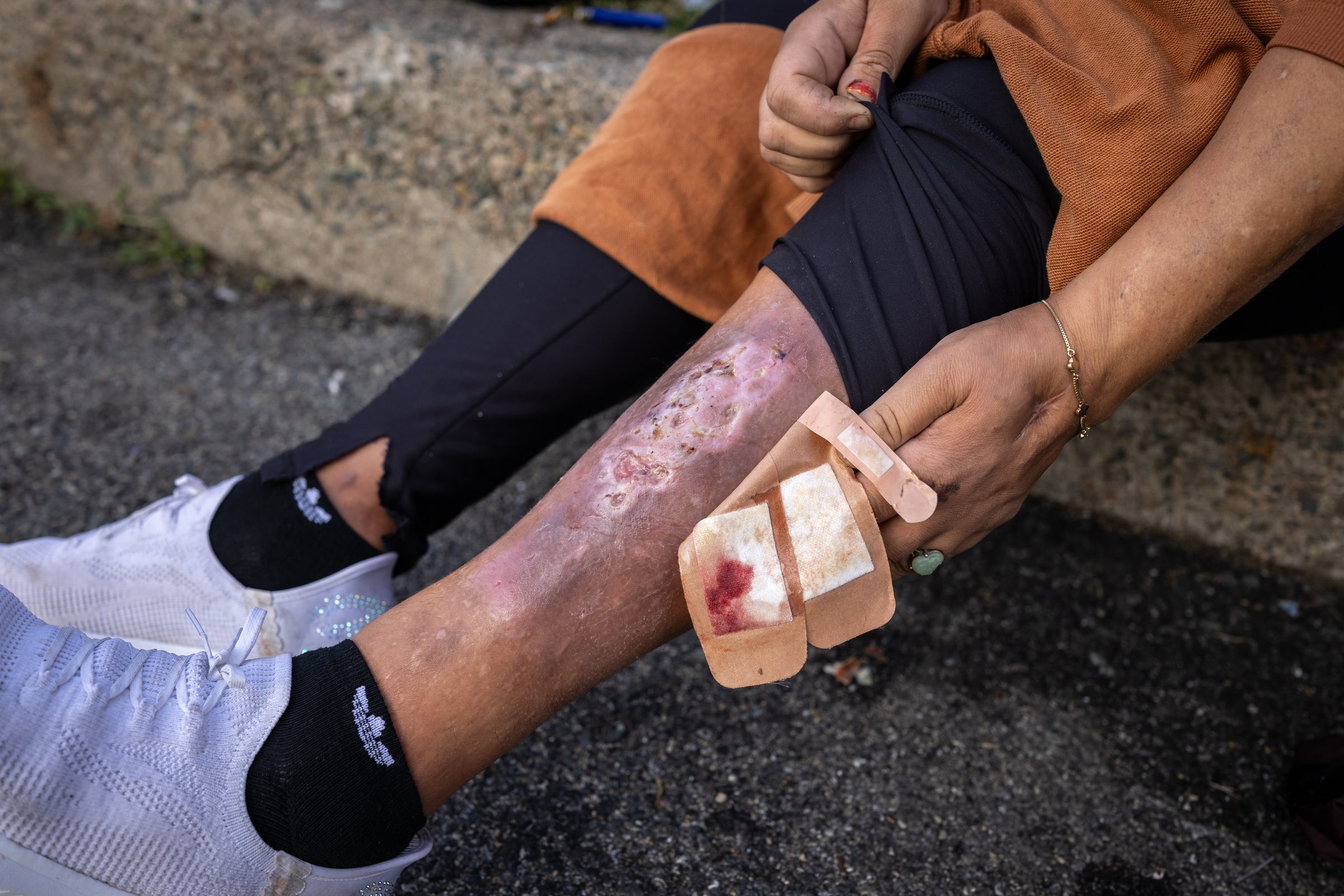
One of them pulled up the leg of her pants. The skin is gone in patches. What is underneath is wet and pink and yellow at the edges, and the dressings she peeled back had bled through. She said it hurts, the way you would report the weather.
She believes it is what is in the syringe that is doing it. That belief is common out here, and it is not baseless — the adulterants moving through the current supply are opening wounds like this on people across the country — but her account of the cause is hers, and it was not verified by anyone qualified to verify it.
She has tried to get clean. She said it was difficult, and that she keeps finding her way back to this street. She has lost more than a hundred pounds. She attributes that to the crack, and she said it as though it were a benefit.
The other one carries mace.
A fight started on the other side of the street. A woman began punching a man. What it was about is unknown and nobody asked.
He pulled a knife on her. He did not use it. He backed off, and a group of people moved in between them, and it was finished in less time than it takes to describe. Nobody called anyone. There was no siren, no van, no response of any kind, and within a minute the street had gone back to looking like nothing was happening on it.
That is what a stabbing on the Mile looks like right up until the moment it becomes one.
There is a lot on the industrial edge of these blocks where women are sold and sell themselves.
The question was put to two women and to three men, separately, without leading and without naming what the answer was expected to be.
All five said yes.
Five witness accounts, gathered independently, sitting alongside a federal conviction out of this district in which a man kept a tent on this street as a hub, brought women there to meet buyers, and took the money. The trade did not end when the encampment did. It relocated, the same way everything else out here relocated.
The boxes on that lot are left unlocked overnight. A woman working the area described the arrangement: the doors stay open so people have somewhere to sleep, and staff at the lot take dates. She described instances of people paying for the use of a truck. An hour, a box, a price. She said a great deal happens inside them, and none of it good.
An attempt to make photographs there ended quickly. A man watching from the fence line said he wouldn't do that if he were you.
What is not a rumor is the drink.
Vehicles pull up on these blocks. A man offers something to drink and the drink is what does it. He rapes them after. Every woman asked knew about it. Nobody had to be prompted and nobody hedged, and the accounts matched each other in the details that matter without ever having been given in the same room.
Not all of it is that. Some of it is what the women out here call a date — an arrangement, a price, a drug at the end of it, entered into by someone who is sick and has no other way to stop being sick. The same vehicle can be either. That is the part that does not survive being written down cleanly: the difference between a transaction and an assault, on this street, is often only whether the woman was conscious for it.
Asked whether anyone reports it, the question landed the way it was always going to land.
And it is not only the women. One of the three men said that men on the Mile have been raped too — not by the man in the vehicle, but by someone who finds people at their lowest, when they are sick and cannot stand, and who presents himself as help. That is a single secondhand account, with no second source and no documentation, and it is flagged here rather than buried. It stays in because this is the kind of thing that goes unreported permanently if nobody writes down the first line.
There is also a rumor on the Mile that a serial killer is working these blocks. It came from more than one person. It cannot be confirmed — no case number, no name, no body, no reporting that substantiates any part of it — and a claim of that size does not become true through repetition.
It stays in because the rumor is doing work whether or not it is accurate. It shapes how women move out here, who they will get into a vehicle with, and what they are willing to risk to stay warm.
One of the three men had been composed the night before. Clear, steady, easy to talk to. Twenty-four hours later he was still up, on a bike, working the blocks for the next one.
Same man, one day apart. That is the cycle, and it does not take a paragraph to explain it.
Devin wants to be free. He said it plainly and it has not been possible to put down since.
So did the man from Ohio, who could not leave this city because someone took his name off him and stole it back every time he saved for the ticket home. So does Tanya, who tried to get clean more times than she could count and was returned to the street each time. So does Becca, who holds a voucher she cannot use. So does the man from Caracas, who walked two children through the Darién Gap to arrive at a sidewalk in Boston.
Every person on this street is trying to get out of something. The drug. The shelter. The cold. Their own body. The attention of the city.
And every answer the city has offered — the sweeps, the tents, the vans idling at the corner, the choice between a detox bed and a cell — has amounted to another decision about where they are permitted to stand.
The crisis used to have an address. Now it has a hundred addresses and none, and the people inside it have learned that being seen is the thing that costs them. It has moved into the tow yards and the loading bays and the lots where the trailers block the sightlines, and what happens there happens without witnesses, which was always the point.
This account has carried the same title since 2023, and it stays. It is the record of a first visit and of what a first visit allowed a person to believe — that a morning was enough, that this was a place you could walk into, photograph, and leave. It has been accurate about nothing since. The morning became an evening, and the evening became a loading dock behind a wall of trailers where nobody could see.
They took the tents. They never took the Mile.
Drugs are plentiful. Hope is all but gone.
And the man who has stood here fourteen years says it is quiet right now, and that quiet is the part he does not trust.
Alexander Carrigg is an American photographer and freelance journalist documenting issues of historical significance including political unrest, conflict, and humanitarian crisis. AlexanderCarrigg.com